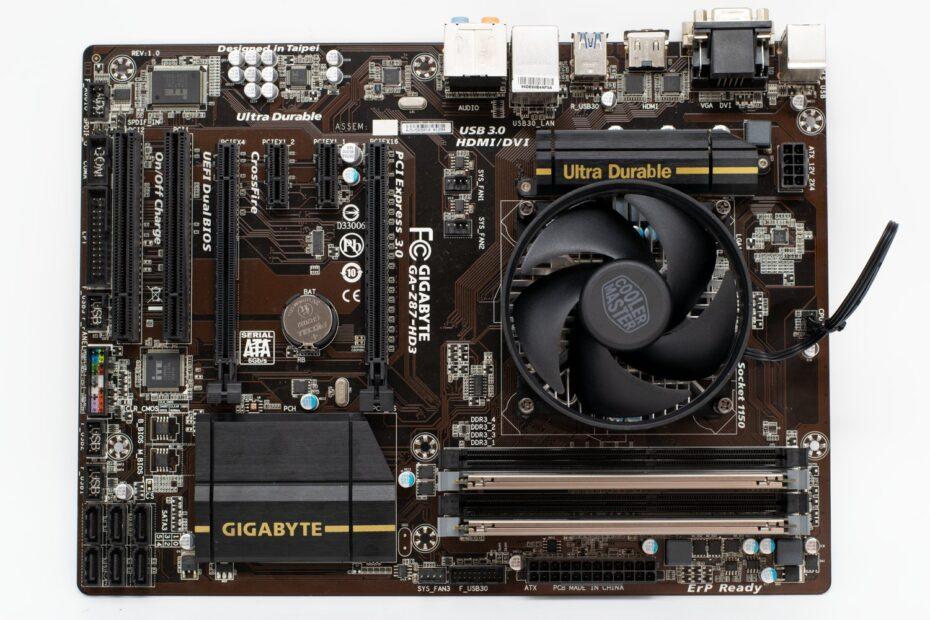
In the evolution of personal computer hardware, motherboard architecture has undergone significant transformations. For many years, a two-chip solution, known as the Northbridge and Southbridge, formed the core of a motherboard's chipset. These chips were critical for managing data flow between the CPU, memory, and various peripherals, effectively acting as traffic controllers for the system's internal communications.
Understanding the Northbridge
The Northbridge, often referred to as the Memory Controller Hub (MCH) in Intel systems, was the higher-performance chip in this duo. Its primary responsibilities revolved around high-speed communication pathways. This included direct connections to the CPU, typically via a front-side bus (FSB) or a similar high-speed interconnect. The Northbridge also housed the memory controller, which managed the flow of data between the CPU and the system's RAM. Furthermore, it controlled the graphics port, such as AGP (Accelerated Graphics Port) or early PCI Express lanes, which were essential for connecting the graphics card. Because of its direct connection to the CPU and its management of critical, high-bandwidth components like RAM and the graphics card, the Northbridge often generated significant heat and was typically located closest to the CPU socket.
The Function of the Southbridge
The Southbridge, or I/O Controller Hub (ICH) in Intel terminology, handled the less speed-critical, but equally vital, input/output (I/O) functions. It acted as a central hub for a wider array of slower peripherals and interfaces. This included managing connections for storage devices like IDE or SATA hard drives and optical drives. The Southbridge was also responsible for providing support for PCI (Peripheral Component Interconnect) slots, USB ports, integrated audio controllers, network interfaces (Ethernet), and legacy ports such as PS/2 for keyboards and mice. Unlike the Northbridge, the Southbridge did not communicate directly with the CPU at the highest speeds; instead, it communicated with the Northbridge through a dedicated bus, often referred to as the Hub Interface or DMI (Direct Media Interface).
The Interplay Between Northbridge and Southbridge
The dual-chip design created a hierarchical structure for data transfer. The CPU would send instructions and data to the Northbridge, which would then direct it to the appropriate destination – either the RAM, the graphics card, or the Southbridge. If the destination was a peripheral managed by the Southbridge (like a hard drive or a USB device), the Northbridge would pass the data to the Southbridge. The Southbridge would then handle the communication with the specific peripheral. This division of labor allowed for more efficient management of different types of data traffic, with the Northbridge focusing on high-bandwidth, latency-sensitive operations and the Southbridge managing a broader range of I/O operations. The overall performance of the system was heavily influenced by the capabilities and interconnect speeds of these two chips.
The Evolution Beyond Northbridge and Southbridge
The architecture described above, centered on The Role of the Northbridge and Southbridge in Older Motherboard Architectures, was the standard for many years. However, advancements in processor technology and chipset design led to a gradual consolidation of functions. In modern motherboards, many of the Northbridge's responsibilities, such as the memory controller and PCI Express lanes for graphics, have been integrated directly into the CPU itself. The remaining functions traditionally handled by the Northbridge and the entire Southbridge have often been consolidated into a single chip, commonly referred to as the Platform Controller Hub (PCH) in Intel systems. This shift to a more integrated design reduces the number of chips on the motherboard, lowers power consumption, and can improve performance by shortening data paths. While the distinct Northbridge and Southbridge chips are largely absent in contemporary PC builds, understanding their historical roles provides valuable insight into the foundational principles of computer system design and the evolution of PC hardware.